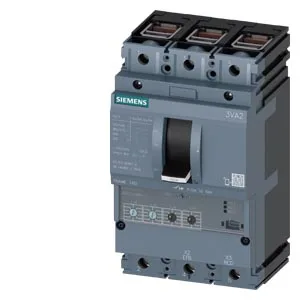
What this MCCB is and what it does
The Siemens 3VA2116-8HM36-0AA0 is a SENTRON molded case circuit breaker (MCCB) designed for line protection — meaning it sits on the incoming feeder to protect cables and busbars from overcurrent and short-circuit faults, not a specific motor or load branch. Rated continuous current is 160 A, and it holds that rating flat across the full ambient range from 40 °C to 70 °C — no derating curve to chase in a hot panel. Breaking capacity is the headline: 440 kA at 240 V AC, 330 kA at 415 V and 440 V, 220 kA at 500 V, and 52.5 kA at 690 V. That 440 kA figure at 240 V means it can interrupt a fault current up to 440,000 A without welding or rupturing — relevant for high-capacity transformer secondaries or large busway feeds where available fault current is extreme. Rated insulation voltage is 800 V, so the internal clearances and creepage are sized for 690 V systems with margin.
Physical fit and panel integration
Three-pole block, 105 mm wide, 181 mm tall, 86 mm deep. That 86 mm depth (3.39 in) is the dimension that matters for shallow enclosure back-pan clearance — verify your gland plate depth before committing. Maximum power loss is 19.7 W per pole at rated current. Operating temperature range is -25 °C to 70 °C; storage range is -40 °C to 80 °C. The storage limit governs handling and warehousing, not running conditions.
What the ratings mean for your decision
The 160 A continuous rating is the current the breaker carries without tripping under normal load. The adjustable thermal-magnetic trip unit (indicated by the 32 A minimum and 160 A full-scale values) lets you set the overload pickup to match the cable or busway ampacity — not fixed at 160 A. No undervoltage release, no voltage trip, no communication module, no trip indicator on this variant. It's a basic line-protection MCCB — if you need shunt trip, auxiliary contacts, or remote monitoring, this isn't the version. Ground-fault monitoring is present but configured as summation current formation on the L-conductor — that's a residual-current detection method, not a full ground-fault protection relay. It monitors the vector sum of the phase currents; if you need a dedicated GFCI function, plan an external module.
