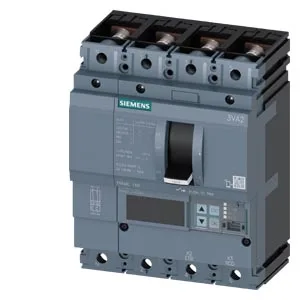
Its adjustable trip range spans 38 A minimum to 300 A maximum, so the same frame can be tuned to protect a 40 A feeder or a 250 A main — the 25 A continuous rating is the thermal baseline the breaker is calibrated to carry indefinitely without tripping at 40 °C ambient. Breaking capacity is 440 kA at 415 V and 187 kA at 690 V, which means it can safely interrupt fault currents up to those levels without cascading upstream — relevant for high-fault-capacity industrial switchboards where a standard 50 kA MCCB would need a current-limiting fuse ahead of it. The ETU860 release supports communication, ground-fault monitoring via summation current formation on L+N, and adjustable N-conductor protection from OFF through 40% to 160% of the phase setting. That makes it suitable for 4-wire systems where neutral protection must be coordinated with the phase trip.
The 140 mm width on a 4-pole MCCB is standard for a 160 A frame — it occupies three 45 mm module spaces plus one 50 mm space on a DIN rail or bolts directly to a mounting plate.
For a BOM freeze or second-source gate: the closest functional peer within the same SENTRON family is the 5SQ2670-2YA63, which also carries an ETU860 release and similar frame size. The 3VA2125-0KQ42-0AA0 is the standard catalog variant; the 5SQ prefix typically denotes a configured or project-specific order code. If your panel was built around a 5SQ2670-2YA63, the 3VA2125-0KQ42-0AA0 will drop into the same footprint and wiring — same pole count, same release family, same mounting dimensions — but verify the configured trip settings on the 5SQ part match your coordination study before swapping.