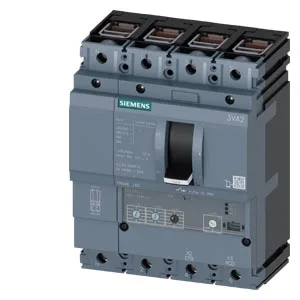
It carries an ETU320 electronic overcurrent release, which gives you adjustable thermal-magnetic or electronic trip curves depending on the release variant — here it's the electronic trip unit with LSI protection (long-time, short-time, instantaneous).
At 240 V it's rated 440 kA — that's a very high interrupting rating, typical for a current-limiting MCCB used close to the transformer secondary. At 415/440 V it's 330 kA, at 500 V it's 220 kA, and at 690 V it's 52.5 kA. These numbers tell you the breaker can handle high available fault currents on low-voltage systems, but you still need to verify the SCCR at your specific system voltage and the upstream protective device coordination.
Physical fit — panel space and mounting
The depth of 86 mm (3.39 in) matters when you're laying out the gland plate or enclosure depth; it's a relatively shallow breaker, so it clears most 200 mm deep enclosures without crowding the door or busbars.
What the ETU320 release gives you
It's adjustable, so you can set the pickup and delay to coordinate with downstream breakers and avoid nuisance trips on motor inrush or transformer energization. The 40 A continuous rating is the frame's maximum; you can set the long-time pickup lower if the load draws less.
Temperature performance — no derating up to 70 °C
That's unusual — most MCCBs start derating above 40 °C. If your panel is in a hot factory, boiler room, or outdoor cabinet in direct sun, this breaker won't force you to oversize the frame just to handle the ambient heat.
Power loss and auxiliary functions
It's a straight line-protection device: no bells, no remote monitoring. If you need shunt trip, UVR, or auxiliary contacts, those are add-on accessories that mount to the breaker's accessory slots, but they're not included on this order code. Ground-fault monitoring is also not built in.