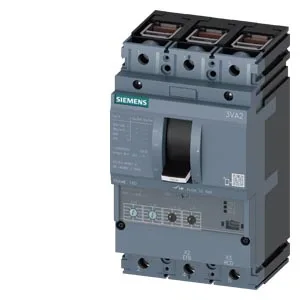
Line protection design (per IEC 81346-2 function Q), meaning it sits upstream protecting a feeder or distribution bus, not a specific motor load. That's a serious SCCR — it can clear a bolted fault at those levels without venting or cascading upstream. For a 63 A frame, that kind of breaking capacity means it's sized for high-fault panels (large transformer secondaries, industrial distribution) where a standard 25 kA or 36 kA MCCB would weld its contacts shut.
Front IP40 protection (finger-safe terminals when the door is closed).
Selectivity and coordination
That matters for selectivity: you can set the short-time delay so a downstream 63 A MCCB clears a fault before this upstream breaker sees it, keeping the rest of the bus live.