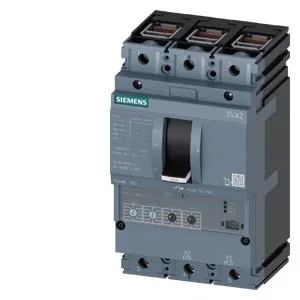
The Siemens SENTRON 3VA2163-5HN36-0CH0 is a 3-pole molded case circuit breaker rated for 63 A continuous current across its full ambient range from 40 °C to 70 °C — no derating needed up to that ceiling. Breaking capacity hits 187 kA at 240 V, 121 kA at 415/440 V, 75.6 kA at 500 V, and 3.7 kA at 690 V. This is a line-protection design, not a motor-protective or feeder-only breaker.
Physical fit — what the 86 mm depth means for panel layout
The 86 mm depth is the critical number for enclosure depth — standard 200 mm deep enclosures leave comfortable wiring space behind the breaker. Width of 105 mm for a 3-pole MCCB is typical for the SENTRON 3VA frame; it occupies roughly 4 inches of DIN-rail or mounting-plate width. Verify gland-plate clearance for the UVR wiring and auxiliary switch cables before final assembly.
What you get in the box — auxiliary releases and switches
No ground-fault monitoring version, no communication function, no voltage trigger. The trip indicator is present — a visual flag on the breaker face shows tripped state without needing to read the handle position.