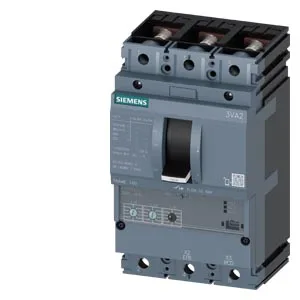
The Siemens 3VA2163-5HL32-0JB0 is a SENTRON 3VA2 molded case circuit breaker (MCCB) rated for 63 A continuous current across the full ambient temperature range from 40 °C to 70 °C — no derating needed as the panel warms up. That 63 A holds steady at every point in that range, so you don't have to oversize the frame for a hot enclosure. The interrupting capacity is 187 kA at 240 V, 121 kA at 415 V and 440 V, 75.6 kA at 500 V, and 3.7 kA at 690 V. For a 480 V panel, the 75.6 kA rating gives you solid headroom against a high-fault utility transformer; the 3.7 kA at 690 V tells you this frame is not the right choice for 600 V class high-fault applications. The three-pole design fits standard 3-phase feeder or motor branch circuits.
Trip unit and auxiliary release — what you actually get inside
This MCCB ships with the ETU320 electronic overcurrent release, which is the basic electronic trip unit in the 3VA2 family — it handles overload and short-circuit protection but lacks the communication and ground-fault monitoring of the higher-tier ETU330 or ETU350. The auxiliary release fitted here is a shunt trip (STL), designated as "2 auxiliary switches HP" in the design.
Footprint and panel fit — dimensions that matter for a swap
The difference between the -0JB0 and -0DB0 is the auxiliary release configuration, not the mechanical fit.