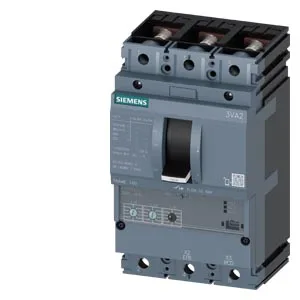
Its interrupting capacity reaches 187 kA at 240 V AC, dropping to 121 kA at 415 V and 440 V, then to 75.6 kA at 500 V, and 3.7 kA at 690 V. That 187 kA at 240 V is the figure that governs high-fault installations like large transformer secondaries or utility entrance panels; the 690 V rating tells you this is not a 690 V main — it's a 480 V class breaker with a residual 690 V rating for lightly faulted circuits.
Selectivity and coordination
The trip indicator gives a visible flag after a fault event, which speeds troubleshooting on a panel with multiple breakers. The undervoltage release (UVR) drops the breaker when control voltage falls below a threshold; this is typical for emergency-stop chains or undervoltage protection schemes where you want the breaker to open on loss of control power, not just on overcurrent.
Panel integration
Dimensions are 105 mm wide, 181 mm high, 86 mm deep — a standard 3-pole MCCB footprint for a 63 A frame. The 105 mm width fits a 4-inch (101.6 mm) DIN-rail or panel-mount pattern with minimal overhang. Maximum power loss is 6.5 W, which is modest for this class; no forced cooling needed in a ventilated enclosure.
Auxiliary and alarm contacts
That gives you four discrete signals: two for position feedback (open/closed), one for a trip event, and one for an electrical alarm condition. The auxiliary release is an undervoltage release (UVR) — no shunt trip, no ground-fault module. If you need shunt trip or ground-fault monitoring, you are looking at a different order-code suffix.