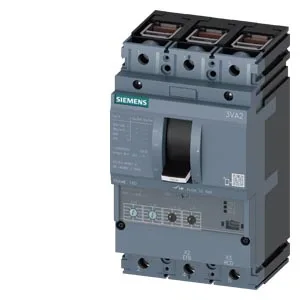
It's fitted with an ETU350 electronic overcurrent release, which provides adjustable long-time, short-time, and instantaneous protection curves — not just a thermal-magnetic fixed trip.
The interrupting ratings span the common industrial voltages: 187 kA at 240 V, 121 kA at both 415 V and 440 V, 79 kA at 500 V, and 4.25 kA at 690 V. At 415 V — the most common three-phase distribution voltage in much of the world — 121 kA covers nearly any secondary substation fault level you'll encounter.
Above that, it derates linearly: 60.6 A at 55 °C, 58.3 A at 60 °C, 55.9 A at 65 °C, and 53.6 A at 70 °C. The dimensions are 105 mm wide by 181 mm tall by 86 mm deep, which is the standard 3-pole SENTRON 3VA2 frame footprint. Panel cutout and busbar spacing match the rest of the 3VA2 family, so swapping in a different rating or trip unit later doesn't require re-drilling the gland plate.
Auxiliary wiring and release coordination
The undervoltage release (UVR) is a separate device that must be wired to a control voltage — typically 24 VDC or 110-240 VAC depending on the specific UVR variant ordered with the breaker. When that control voltage drops, the UVR trips the MCCB instantly. The auxiliary contact block provides 2 form-C (changeover) auxiliary switches for status feedback, plus a dedicated trip alarm switch and an electrical alarm switch. These are useful for PLC inputs that need to distinguish between a manual open and a fault trip. Maximum power loss through the breaker at rated current is 6.5 W, which is modest for a 63 A electronic-trip MCCB and won't drive significant internal heating in a ventilated enclosure.