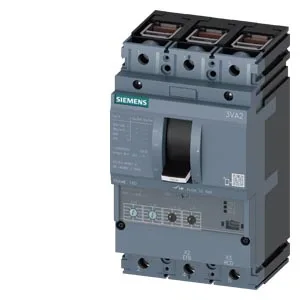
What this MCCB delivers
The Siemens SENTRON 3VA2163-5HN36-0KL0 is a 3-pole molded case circuit breaker rated for 63 A continuous current (Iu) with an ETU350 electronic trip unit. It's configured for line protection — meaning it sits at the feeder or main distribution point, not on a motor branch. The 187 kA breaking capacity at 240 V and 121 kA at 415 V tell you this breaker handles high-fault-current scenarios typical of large panelboards or transformer secondaries. The ETU350 provides adjustable long-time, short-time, instantaneous, and ground-fault protection curves, giving the commissioning engineer flexibility to coordinate with downstream breakers without swapping trip units. The auxiliary contact configuration — 2 auxiliary switches + 1 trip alarm switch + 1 electrical alarm switch HQ — gives the panel builder a full set of status signals for PLC or SCADA monitoring without adding external relay blocks. The shunt trip release (STL) is built in, so remote tripping via a pushbutton or safety relay is ready out of the box.
Sizing and thermal derating
The 63 A rating holds flat from 40 °C to 50 °C (–). Above that, it derates linearly: 60.6 A at 55 °C, 58.3 A at 60 °C, 55.9 A at 65 °C, and 53.6 A at 70 °C (–). For a panel OEM stuffing this into a 105 mm wide × 181 mm high × 86 mm deep (–) enclosure, the derating curve means you can push the full 63 A up to 50 °C ambient — common in ventilated industrial panels — but need to account for the drop in sealed, high-temp cabinets. The 4 W maximum power loss is modest; heat dissipation won't drive fan sizing on its own.
Panel fit and wiring notes
The 3VA2 frame mounts on a DIN rail or directly to a backplate via the four mounting slots. At 105 mm wide, it occupies three 35 mm DIN modules plus a bit — standard for a 3-pole MCCB in this class. The line and load terminals accept copper or aluminum conductors up to the manufacturer's specified lug range; the integrated shunt trip (STL) wiring lands on the auxiliary terminal block, keeping control wiring separate from the power path. The trip indicator gives a visual red flag when the breaker has tripped on fault, not just been switched off — useful for field service techs troubleshooting a downstream short.
