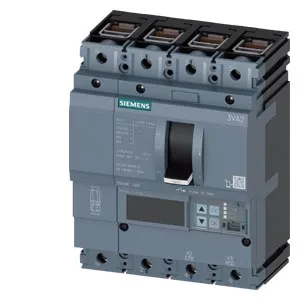
It carries a continuous rated current of 63 A across an ambient temperature range from -25 °C to 70 °C without derating — every temperature point from 40 °C through 70 °C lists the same 63 A, so the thermal curve is flat across normal panel conditions. The ETU550 electronic trip unit handles the overcurrent release, giving adjustable pickup and time-delay settings that let you coordinate with downstream breakers instead of relying on fixed thermal-magnetic curves. The breaking capacity tells you where this breaker can sit in the fault-current hierarchy: 242 kA at 240 V, 187 kA at 415 V and 440 V, 121 kA at 500 V, and 3.7 kA at 690 V.
The 140 mm width, 181 mm height, and 86 mm depth are the same 4-pole 3VA2 envelope.
The 4-pole width of 140 mm is the same as other 3VA2 4-pole units, so if you are swapping out an older 3VA2 variant, the busbar and lug positions align without re-drilling the gland plate. Power loss is listed at a maximum of 4 W. That is low enough that derating for adjacent breakers in a multi-unit enclosure is minimal, but if you are packing six or more 63 A MCCBs in a single section, you still want to check the internal temperature rise against the 70 °C operating maximum. The ETU550 electronic trip draws its power from the current itself — no auxiliary supply needed for the trip unit, which simplifies wiring.