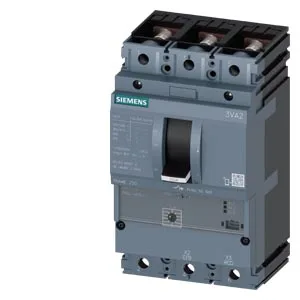
The adjustable thermal-magnetic trip unit covers a 600 A to 3000 A range, so this frame size can be tuned to protect a wide spread of motor full-load currents or feeder circuits.
Breaking capacity — where this breaker lives in the fault-current hierarchy
Breaking capacity is the make-or-break selection parameter for an MCCB. At 240 V this unit interrupts 330 kA, which puts it in the high-interrupting category — it can be installed at the main or feeder level where fault currents are highest. At 415 V and 440 V it still delivers 242 kA, and at 500 V it holds 187 kA. The sharp drop to 5.2 kA at 690 V tells you this is a 480 V class breaker, not a 690 V main; at 690 V it's limited to light-duty subfeeder applications.
Built-in auxiliary and shunt trip — panel wiring note
That means you get remote status indication (open/closed/tripped) and remote trip capability without ordering separate accessory kits or opening the breaker cover. The shunt trip is wired to a control voltage — typically 24 VDC or 120 VAC — and lets a safety PLC or E-stop circuit kill the breaker remotely. The basic switch assembly is order code 3VA2220-7MS32-0AA0, which is the underlying thermal-magnetic mechanism.