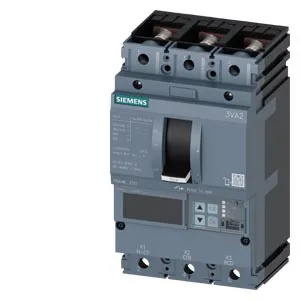
Molded Case Circuit Breaker for Line Protection
The SENTRON 3VA2225-6JQ32-0HL0 is a 3-pole molded case circuit breaker (MCCB) designed for line protection, carrying a continuous current rating of 250 A at 40 °C and maintaining that rating through 50 °C, then derating to 238 A at 55 °C, 225 A at 60 °C, 213 A at 65 °C, and 200 A at 70 °C. Breaking capacity is rated at 242 kA at 240 V, 187 kA at 415 V and 440 V, 121 kA at 500 V, and 4.5 kA at 690 V. The steep drop at 690 V reflects the arc-extinction limits of the 3-pole design at higher line-to-line voltages; for 690 V applications, verify the available fault current stays under 4.5 kA. A voltage trigger is present, and a trip indicator provides local visual status. Communication function is built in, supporting integration with higher-level monitoring or control systems.
Physical footprint: 181 mm height, 105 mm width, 86 mm depth. Depth of 86 mm leaves clearance behind the gland plate for wiring and the shunt trip harness.
Electrical and Environmental Ratings
The adjustable thermal-magnetic trip unit is set at the factory with an initial value of 50 A and a full-scale value of 250 A.