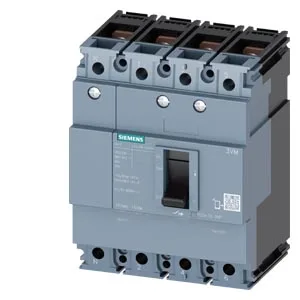
The SENTRON 3VM1110-3EE36-0AA2 is a 3-pole molded case circuit breaker (MCCB) from the 3VM1 frame, rated for 100 A continuous current at 40 °C and carrying a class N breaking capacity of 76 kA at 240 V AC. It's a line-protection device with a TM220 thermal-magnetic release — the thermal element adjustable from 70 A to 100 A, the magnetic fixed at 10× In. That means for a 100 A feeder, the instantaneous trip sits at 1000 A, which keeps it selective downstream of most 160 A–250 A upstream breakers in a typical 480 V distribution panel.
This MCCB's interrupting rating drops as voltage rises: 76 kA at 240 V, 53 kA at 415 V, 32 kA at 440 V, and 11.9 kA at 500 V. If your SCCR study shows fault current above 53 kA at 415 V, you need the class S or H version.
Above that, it steps down: 98 A at 55 °C, 96 A at 60 °C, 94 A at 65 °C, and 91 A at 70 °C.
What's in the box — connections and accessories
The main circuit connects via box terminals on the front — standard for panel wiring with ring lugs or fork terminals. No auxiliary contacts come built in (0 CO contacts), and there's no provision for a motor drive or neutral conductor upgrade. Communication function is absent, so no Modbus or PROFIBUS integration here — it's a straight electromechanical breaker.