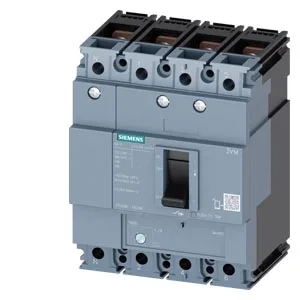
Its TM220 thermal-magnetic release provides fixed overload and short-circuit protection curves — no interchangeable trip units, so the trip setting is locked at the factory. Rated 125 A continuous at 40 °C, it holds that current flat through 50 °C (125 A at 50 °C), then derates linearly to 114 A at 70 °C. That thermal stability means you don't lose headroom in a warm enclosure until you're well above typical panel ambient. Breaking capacity is the real selector here: 76 kA at 240 V AC, 53 kA at 415 V AC, 32 kA at 440 V AC, and 12 kA at 500 V AC. At 415 V — common for European industrial distribution — the 53 kA figure puts it in the high-fault tier for a 125 A frame.
Maximum power loss is 23 W — that's the heat it dumps into the enclosure at full rated current. For a panel designer, that's the number to plug into the thermal rise calculation. If you're retrofitting this into an existing panel that ran cooler, verify the enclosure's dissipation capacity doesn't exceed the rated rise.
Dimensions: 70 mm deep, 101.6 mm wide (4 inches), 130 mm high (5.12 inches). The 4-pole width at 101.6 mm is the standard 4-inch MCCB footprint for this class — it fits Siemens SENTRON mounting bases and most DIN-rail adapters for 4-pole frames. The N-conductor protection is rated at 100% — meaning the neutral pole is fully rated, not reduced. That matters for 4-wire systems where the neutral carries phase imbalance current. No ground-fault monitoring version is fitted, so this is a straight overcurrent-only device.