Breaking capacity — what it means on your line
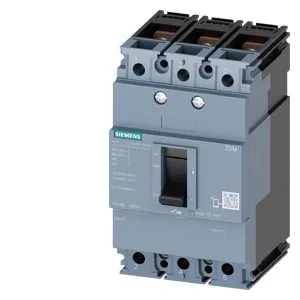
The 3VM1112-4ED32-0AA0: This breaker is rated to interrupt 121 kA at 240 V AC, 76 kA at 415 V, 53 kA at 440 V, and 12 kA at 500 V. Those numbers govern where it can sit in a distribution panel — if your fault current at the bus is 80 kA at 415 V, this holds. If it's 90 kA, you need a higher-rated frame upstream or a current-limiting feeder. The 1 250 A maximum rating on the frame means it's a compact 125 A trip unit in a frame that can handle bigger internals — useful if you ever uprate the tap.
Thermal derating — the real-world current
At 55 °C it's 122 A, at 60 °C it's 120 A, at 65 °C it's 117 A, and at 70 °C it's 114 A. If this lives in a hot panel next to drives or transformers, size your load at the 70 °C number, not the 40 °C sticker. The TM210 release is a thermal-magnetic type — thermal for overload, magnetic for short-circuit — so the trip curve is fixed; no electronic adjustment for coordination studies.
Dimensions are 130 mm high, 76.2 mm wide, 70 mm deep — a compact 3-pole MCCB that fits standard distribution panelboards. Power loss is 23 W maximum — factor that into enclosure ventilation if you're packing several in a small can.