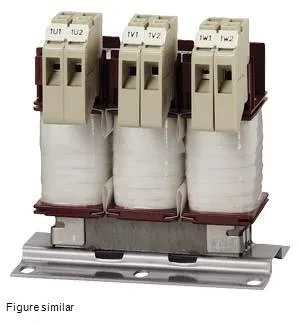
Commutating Choke for Converter Applications
The Siemens 4EP3700-7DS00 is a 3-phase commutating choke designed for line-side or load-side use with converters (variable-frequency drives, rectifiers). It is rated for 400 V AC at 50 Hz, with a continuous rated current of 56.7 A and a maximum current of 63 A. The inductance is 0.22 mH, and the relative inductive voltage drop is 2% at the rated current and frequency — a standard value for limiting di/dt and reducing harmonic distortion in the DC link or motor circuit.
The 56.7 A rated current (Ith) is the continuous thermal current at 40 °C ambient, thermal class B (130 °C insulation system per IEC 60085). This means the choke can carry 56.7 A indefinitely without exceeding the temperature rise limit — sizing it for a drive with a continuous output current at or below that figure. The 63 A maximum (Ithmax) is the short-time overload capability, typically for starting or transient conditions. The 2% voltage drop at rated current is the impedance that provides the smoothing and commutation benefit; a higher percentage would increase losses and voltage sag, a lower percentage would reduce filtering effectiveness. For a 400 V line, 2% is 8 V — negligible for most drive input stages.
Physical Integration and Mounting
The choke measures 0.178 m wide, 0.153 m high, and 0.105 m deep. The thermal class B insulation allows a 130 °C hot-spot temperature; ensure adequate ventilation or forced cooling if the ambient inside the panel exceeds 40 °C.
Total power loss at rated conditions is 63 W — 50 W in the coil (copper losses) and 13 W in the iron core (hysteresis and eddy-current losses). This heat must be dissipated within the panel. For a 56.7 A continuous load, 63 W is modest; a typical DIN-rail cabinet with natural convection can handle it, but verify that adjacent components are not thermally derated.