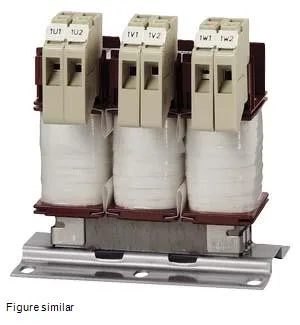
What this mains choke does
The Siemens 4EP3910-7AS10 is a Netzdrossel — a three-phase AC mains choke (line reactor) rated 50 A maximum, 45 A nominal, at 500 V operating voltage. It's the component that sits between the supply and a drive or converter to limit harmonic currents, smooth line notching, and protect the DC bus from transient spikes. The 0.57 mH inductance per phase, combined with a 3 % relative inductive voltage drop at rated current, tells you it's sized for moderate harmonic mitigation — enough to keep a 6-pulse drive within typical IEEE 519 limits for a weak grid, but not a heavy-duty DC-link choke.
IP00 open-frame construction — no enclosure, no touch protection. This choke mounts inside a panel or cabinet, not on a DIN rail. Dimensions: 0.219 m wide, 0.179 m tall, 0.123 m deep. Connection is via free cable ends, so you'll terminate directly to a terminal block or busbar. Thermal class B insulation per IEC 60085 means the winding can handle a 130 °C hot-spot temperature; the total power loss breaks down to 43.8 W in the coil plus 24.2 W in the iron core, so plan for that heat inside the enclosure — forced ventilation or derating above 40 °C ambient.
The 50 A maximum / 45 A rated current at 500 V AC, 50/60 Hz, defines the continuous load this choke can carry. If your drive's DC bus is already marginal on voltage, that drop matters — factor it into the input voltage budget. The 0.57 mH inductance per phase is the value you'd use for harmonic modelling or to check resonance with downstream capacitors. Free cable ends (no lugs) mean you supply the termination hardware; the conductor cross-section isn't listed, but at 50 A you're looking at 10–16 mm² cable depending on local code and ambient.