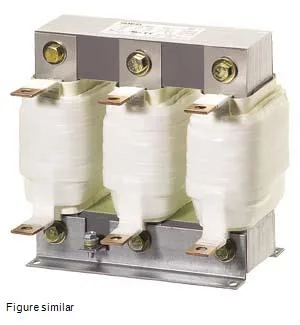
What this output reactor does in the drive line
The Siemens SIDAC 4EU2552-0EF00-4BA0 is a 3-phase output reactor — a choke placed between the variable-frequency drive and the motor to limit the rate of voltage rise (dV/dt) and reduce reflected-wave stress on long cable runs. Rated for a maximum AC current of 25 A and a switching frequency of 8 kHz (rated), it handles fundamental output frequencies from 0 Hz up to 1400 Hz, which covers high-speed spindle and servo applications well beyond standard 50/60 Hz induction motors. The 0.3 mH inductance and 23 % impedance (UK) give it enough series reactance to smooth PWM edges without dropping excessive voltage across the reactor at rated load.
Ratings that govern fit
The 25 A maximum AC current and 22.5 A rated operational current set the motor-side limit — size the reactor so the motor full-load amps stay under the lower of these two figures. The 8 kHz rated switching frequency matches the carrier frequency of most modern IGBT drives; if your drive runs a higher PWM frequency, the reactor's iron-core losses (106 W at rated conditions,) and copper losses (40 W coil loss,) will rise, and the thermal class H insulation (180 °C continuous) provides the headroom. Ambient temperature is rated at 40 °C; above that, derate the current per the standard thermal curve for class H.
Physical integration and wiring
The reactor measures 0.22 m wide, 0.16 m deep, and 0.21 m high — a compact footprint for a 25 A three-phase choke, but IP00 means no enclosure protection. Terminals are flat-type connectors, not ring or fork lugs; expect a busbar or flat-cable interface. The 480 V AC rated voltage covers standard 400 V line supplies with a safety margin.