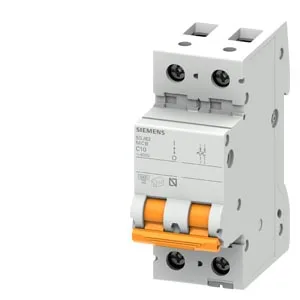
The Siemens 5SJ6216-7 is a SENTRON 5SJ6 miniature circuit breaker (MCB) rated 16 A at 400 V AC with a C-curve trip characteristic, 2-pole construction, and a 6 kA breaking capacity certified to both EN 60898 and IEC 60947-2.
The 16 A rated current at 400 V AC sets the continuous load limit per pole. For a 2-pole breaker on a single-phase line-to-line load (e.g., a 230 V or 400 V split-phase circuit), the full 16 A is available per pole. The C-curve is the deciding factor for selectivity with downstream branch breakers — it holds through motor starting surges up to about 80 A peak (5× In) before the magnetic trip operates, so it coordinates well with B-curve final subcircuits. The DC rating is 60 V maximum, so this 2-pole unit can be used for a single DC circuit up to 60 V with both poles in series for positive isolation. The mechanical service life is 20 000 switching cycles typical — adequate for panel disconnecting duty but not for frequent switching applications like motor starting contactors. Overvoltage category 3 and pollution degree 2 confirm it is rated for fixed-installation distribution boards within a controlled environment.
Drop-In Fit vs. 5SJ6216-6
The only difference between the 5SJ6216-7 (C-curve) and the 5SJ6216-6 (B-curve) is the trip characteristic. Both are 2-pole, 16 A, 6 kA, 400 V, 70 mm depth, 2 MW, same halogen-free/silicon-free construction, same terminal capacity, same mounting position. A panel wired for the B-curve variant accepts the C-curve without any rewiring or mechanical change — the decision is purely about the inrush profile of the downstream load. For moderate inrush (small motors, transformers), the C-curve is correct; for purely resistive or electronic loads where tighter overcurrent protection is preferred, the B-curve fits.