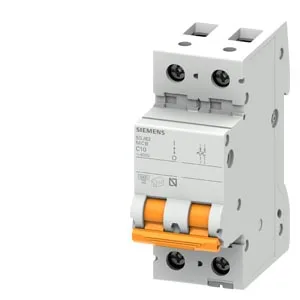
What this MCB does for a panel
Rated 63 A at 30 °C, the breaker occupies 2 modular width units (36 mm) on a DIN rail, with a 76 mm depth that leaves clearance for standard enclosure depths. The 2-pole design switches both phase and neutral in single-phase AC circuits up to 250 V, or two phases in multi-phase operation up to 440 V.
The 5SJ6263-7RC carries a 10 000-cycle mechanical service life, typical for residential and light-commercial grade MCBs. Halogen-free and silicon-free construction means it meets low-smoke, zero-halogen material specs often required in ventilation-constrained or clean-room sub-distribution.
Fit and compliance
Installation depth is 70 mm into the enclosure — the 76 mm overall depth includes the toggle and terminal screws protruding past the rail foot. Sealable terminals (lead-sealable cover) allow the installer to lock the cover after commissioning, a detail often required by utility submetering or tenanted retail spaces. The 50/60 Hz supply frequency covers both 50 Hz European and 60 Hz North American grids, though the 6 kA breaking capacity is rated per EN 60898, not UL 489, so this is a CE-marked part for IEC markets.
How the 63 A C-curve behaves in a real circuit
At 63 A continuous, the thermal bimetal strip carries the full load without tripping. The magnetic trip fires between 315 A and 630 A (5–10× In), which clears hard faults but passes the 8–12× inrush of a 15 kVA transformer or a 7.5 kW motor starting direct-on-line. For circuits where the peak inrush exceeds 630 A — say, multiple large drives on the same feeder — step up to a D-curve or increase the breaker frame. In a panel with a 10 kA upstream transformer, this MCB needs a current-limiting upstream device (a 100 A gG fuse or a higher-rated MCCB) to keep the let-through energy within its rating. Coordination tables are in the Siemens SENTRON selectivity manual.