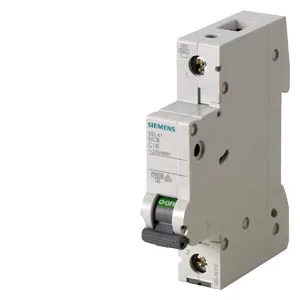
The Siemens 5SL4125-8 is a 1-pole SENTRON miniature circuit breaker (MCB) with a D tripping characteristic, rated 25 A at AC and a 10 kA breaking capacity under both EN 60898 and IEC 60947-2. At 40 °C ambient the continuous rating derates to 23.1 A; at 55 °C it drops to 19.91 A, so if the panel runs hot, size up or account for the thermal curve. Single-pole switching at 250 V AC single-phase, or 440 V AC multi-phase. The DC rating tops at 72 V — fine for control-circuit protection, not for a DC bus.
Occupies one modular width (18 mm) on a DIN rail. Mounting position any, which helps in tight enclosures where the rail is vertical. IP20 with connected conductors; that's expected for a distribution board — no washdown rating, keep it inside the cabinet. Sealable and touch-protected.
The 10 kA breaking capacity at 400 V AC (EN 60898) and the same 10 kA under IEC 60947-2 tell you this MCB can safely interrupt a fault current up to that level without welding contacts or cascading failure upstream. For a panel fed by a transformer with a prospective short-circuit current under 10 kA, this breaker coordinates cleanly. Energy limitation class 3 means it lets through less let-through energy (I²t) than class 1 or 2 — that protects downstream wiring and connected loads during a fault. The 95% humidity tolerance at 55 °C is the upper bound for condensation-prone environments — still keep the enclosure sealed, but the breaker won't be the weak link.