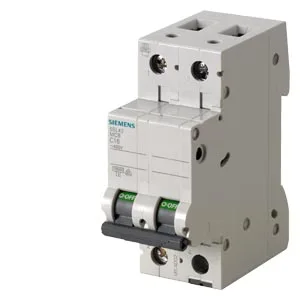
The Z curve is designed for semiconductor protection and other sensitive loads where the inrush current is minimal but short-circuit protection must be fast — it trips between 2.5 and 4 times rated current, which is tighter than a B or C curve. For a 25 A breaker, that means magnetic trip between roughly 62.5 A and 100 A, clearing a fault before the downstream electronics see the full let-through energy.
The 2-pole form factor occupies two DIN-rail modular spaces (typically 36 mm total width per Siemens 5SL series convention). The Z characteristic is the key selection parameter here — if the load is a semiconductor rectifier, a UPS input, or a control transformer with low inrush, this curve matches the protection requirement. A standard C-curve would nuisance-trip on the same load.