What the ratings mean for the panel
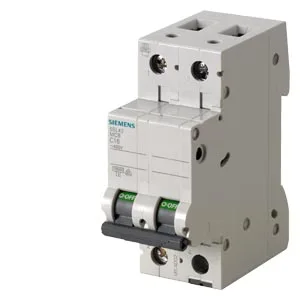
The Siemens 5SL4232-7CC is a 2-pole miniature circuit breaker from the SENTRON family, rated 32 A at 400 V AC with a C tripping characteristic. The C-curve means it trips at 5–10 times rated current — sized for moderate inrush loads like small motors, pumps, and lighting circuits where the starting surge won't nuisance-trip a faster curve. The 10 kA breaking capacity per EN 60898 tells you it can safely interrupt a fault current up to 10,000 A at 400 V AC without welding contacts or cascading upstream. That's the standard for residential and light commercial distribution boards in most IEC markets. Temperature derating is baked in: at 30 °C it holds the full 32 A, but at 50 °C that drops to 26.91 A, and at 55 °C to 25.48 A. If your panel runs hot — say inside a non-climate-controlled enclosure near a molding press or furnace — size the upstream load so the continuous current stays under the derated figure, or the breaker will nuisance-trip on thermal overload even with no fault. The 2-pole design (2P) switches both phase and neutral on a single-phase circuit, or two phases on a split-phase or two-phase system. It occupies 2 modular width units (36 mm) on a standard DIN rail, with an installation depth of 70 mm behind the panel surface and an overall depth of 76 mm including the front. Mounting position is unrestricted — any orientation works. The IP20 rating with connected conductors means it's protected against finger contact but not against moisture; keep it inside a closed panel.
Integration notes for the wireman
Snaps onto standard 35 mm DIN rail. The 36 mm width (2 MW units) fits a standard 18 mm-per-module grid. Sealable design allows the installer to lock the toggle position with a lead seal or adhesive label — useful for tamper-proof circuits in metered or common-area supplies. Supplementary devices like shunt trips or auxiliary contacts can be added on the right side. The breaker is halogen-free and silicon-free, which matters for clean-room or electronics manufacturing environments where outgassing can contaminate contacts or optics. Vibration resistance tested to 50 m/s² at 25 to 150 Hz per IEC 60068-2-6 — adequate for installation on machine-mounted sub-panels near rotating equipment, not just fixed building distribution boards. Overvoltage category III and pollution degree 2 mean it's rated for fixed installation downstream of the main service entrance, in a typical industrial or commercial environment where conductive dust is controlled but not absent.