What it is and what it does
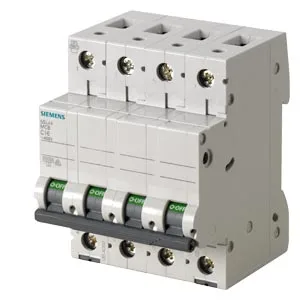
The Siemens 5SL4413-7RC is a 4-pole SENTRON miniature circuit breaker with a C tripping characteristic, rated 13 A at 415 V AC. It breaks 10 kA per EN 60898, so it handles fault currents up to that level without welding contacts or cascading failure upstream. That's the standard residential and light-commercial interrupting rating — fine for distribution boards where the prospective short-circuit current stays under 10 kA. The C-curve means it trips between 5× and 10× rated current — typical for inductive loads like small motors, fluorescent lighting banks, and transformer primaries where you need to ride through inrush without nuisance tripping. At 13 A per pole, it's sized for a 3 kW three-phase motor or a mixed lighting/power subfeed.
Panel fit and wiring
Each pole occupies one 18 mm width unit — four poles across 72 mm of DIN-rail space. The 76 mm depth and 90 mm height keep it inside standard distribution board envelopes. Installation depth is 70 mm, so it clears shallow back panels. Terminals accept 0.75 to 25 mm² solid or stranded copper. Tightening torque is 2.5 to 3 N·m — a standard screwdriver setting, no special tooling. The breaker is sealable, which matters for utility-metered or tamper-proof installations. Touch protection is built in, and IP20 applies when conductors are connected — normal for enclosed distribution boards.
What the ratings mean for your BOM line
Rated voltage is 415 V AC for multi-phase operation, with a maximum of 440 V. Single-phase operation is rated at 250 V. Overvoltage category III means it's designed for fixed installation downstream of the main distribution board — not for equipment-level protection. Energy limiting class 3 gives good let-through energy reduction, which helps with downstream coordination. Mechanical service life is 10 000 switching cycles typical. Ambient temperature range is -25 to +55 °C, storage from -40 to +75 °C. Halogen-free and silicon-free construction — relevant for clean-room or corrosive-environment installations where outgassing matters.