What the ratings mean for a panel fit
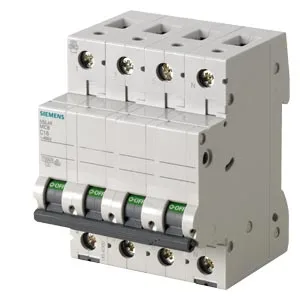
The Siemens SENTRON 5SL4650-8 is a 4-pole (3P+N) miniature circuit breaker with a D tripping characteristic, rated 50 A at 30 °C and 400 V AC. The D-curve means it tolerates high inrush currents — typically motor starts, transformer energization, or welding loads — without nuisance tripping, while still clearing a fault at 10 kA per EN 60898 and IEC 60947-2. That breaking capacity is the same under both standards, so it fits residential, commercial, and light industrial distribution boards where the prospective short-circuit current stays at or below 10 kA. The 4-pole design with neutral switching (3P+N) covers three-phase plus neutral circuits common in European-style panels, and the 4-module width (72 mm) occupies standard 18 mm-per-module DIN-rail spacing.
Temperature derating and ambient limits
The 50 A rating holds at 30 °C. At 40 °C it derates to 47.36 A, at 45 °C to 46 A, and at 55 °C to 43.09 A. If the panel ambient runs warm — say, a crowded enclosure near a furnace line or in a roof-mounted cabinet — use the 40 °C or 55 °C column for conductor sizing and load planning. The breaker itself survives storage from -40 °C to 75 °C, and operates at up to 55 °C with 95% humidity. That's a wide storage range, meaning it can sit in an unheated warehouse or a hot shipping container without damage.
Physical fit and installation
The 5SL4650-8 snaps onto standard 35 mm DIN rail per EN 60715. Dimensions: 72 mm wide (4 modular units), 90 mm high, 76 mm deep. Installation depth is 70 mm, leaving clearance behind the DIN rail for wiring. The IP20 rating applies with connected conductors — standard for enclosed distribution boards. Mounting position is any, so vertical or horizontal rail orientation works. Sealable terminals and touch protection are built in, which matters for installations requiring a lockable cover or tamper-evident seal.
Environmental and material compliance
The breaker is halogen-free and silicon-free, so it won't outgas corrosive compounds in a fire — relevant for installations in data centers, medical facilities, or clean rooms where off-gassing can damage contacts or electronics. Pollution degree 2 and overvoltage category III are standard for fixed-installation distribution boards. The energy limitation class is 3, meaning it limits let-through energy under fault conditions to reduce stress on downstream equipment.
