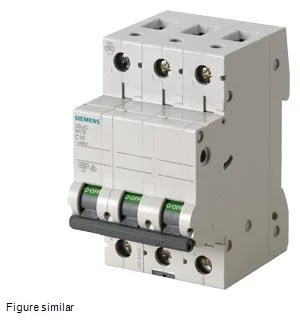
What this MCB is and where it fits
The Siemens 5SL6310-8CC is a 3-pole miniature circuit breaker from the SENTRON family, rated 10 A with a D tripping curve. D-curve means it tolerates high inrush (5–10× rated current) — the right choice for motor, transformer, or lighting ballast circuits where a B- or C-curve would nuisance-trip on startup. The 6 kA breaking capacity at 400 V AC per EN 60898 covers most residential, commercial, and light industrial panel feeds; for higher fault currents on the service entrance you'd step up to an SENTRON 3VA or similar. It's a current-production part — no obsolescence concern for BOM planning.
Sizing and derating — the real numbers
The 10 A rating holds at 30 °C ambient. At 40 °C it derates to 9.43 A; at 50 °C to 8.82 A. If your panel runs at 45 °C (common in a sealed enclosure), you're at 9.13 A continuous — so a 10 A load would need a larger frame. The MCB mounts in any position and takes 3 modular width units (54 mm) on DIN rail, with 76 mm depth behind the panel. Touch-protected terminals and IP20 with conductors connected are standard; sealable for lockout/tagout.
Environmental and compliance
Operating range spans -40 °C to 75 °C, overvoltage category III, pollution degree 2. The breaker is halogen-free and silicon-free — relevant for clean-room or semiconductor-adjacent panels where outgassing can contaminate optics or contacts. Vibration resistance tested at 50 m/s² from 25 to 150 Hz per IEC 60068-2-6, so it holds up on machinery or in mobile equipment.
How it compares to the 5SL4120-7CC
The 5SL4120-7CC is a 2-pole C-curve 20 A breaker — different pole count, curve, and amp rating. The 5SL6310-8CC will not drop into a panel wired for that 2-pole without reconfiguring the busbar and checking the load's inrush characteristic. Stick with the 5SL6310-8CC for a 3-pole D-curve 10 A position; if you need a 3-pole C-curve at a different current, the 5SL series has variants for that.
