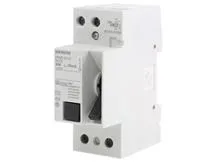
The 230 V AC rated supply voltage matches single-phase line-to-neutral supplies common in European distribution boards. The short-time delayed characteristic means it rides through brief transient leakage spikes (e.g., from motor startup or switching surges) that would nuisance-trip a standard instantaneous RCCB, making it a better fit for circuits with inductive loads or long cable runs. It includes thermal overload protection — a feature that combines overcurrent and residual current protection in one device, saving a DIN slot compared to wiring a separate MCB upstream. Terminals accept solid or stranded conductors from 1 to 16 mm², tightened to 2.5 to 3 N·m.
Integration into a panel — what fits and what doesn't
Mounts on a standard 35 mm DIN rail and occupies 2 modular width units at 70 mm installation depth — fits any standard distribution board sized to DIN 43880 size 1. The IP20 rating is typical for enclosed panel gear; it's finger and back-of-hand safe when installed with conductors connected, but not rated for wet or dusty environments. The silicon-free construction is relevant for potting or conformal-coating processes in certain industrial or automotive panels.
A panel specified around a 5SY4-series MCB (e.g., 5SY4304-7CV, 5SY4316-7CV, or 5SY4350-7CV) cannot simply drop in the 5SM3314-0LA01 without rewiring. The 5SY4 units are 3-pole MCBs with a 3-module width (54 mm) and 76 mm depth, while the 5SM3 RCCB is 2-pole, 2-module width, and 70 mm depth. The 5SY4 series lacks residual current detection and thermal overload protection built-in — it's a straight overcurrent device. If the BOM calls for earth leakage protection on a 230 V single-phase circuit, the 5SM3314-0LA01 is the correct functional choice, but the panel layout and wiring must be revised to match the 2-pole, 2-MU footprint.