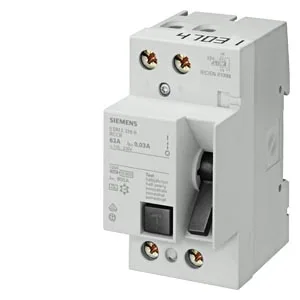
It carries a 100 A rated current and trips at 100 mA residual current — a setting used where a higher threshold is acceptable (e.g., feeder or submain protection, not individual socket-outlet circuits where 30 mA is typical).
Rated at 100 A and 230 V AC, this RCCB handles the full load of a typical main switchboard feeder. The 100 mA trip threshold is deliberate — it avoids nuisance tripping from leakage currents that accumulate on long cable runs or equipment with natural capacitive leakage, while still providing earth-fault protection. The instantaneous design (no intentional delay) means it clears a fault within tens of milliseconds, which is the default for most RCCB applications. The 10 kA SCCR at 230 V AC means the device is rated to withstand and interrupt a short-circuit current up to that magnitude, matching the prospective fault level of a standard domestic or small commercial supply.
Accepts solid or stranded conductors from 1.5 mm² up to 50 mm² — the 50 mm² upper end is generous for a 100 A device, allowing direct connection of the incoming feeder without a separate terminal block. Screw terminals require 3 to 3.5 N·m torque.