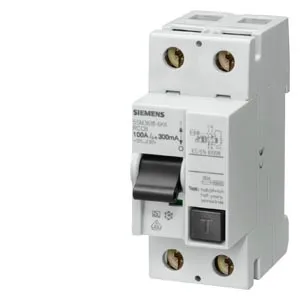
The Siemens SENTRON 5SM3418-6KK is a 2-pole residual current operated circuit breaker (RCCB), Type A, rated 100 A with a 100 mA residual trip threshold, for 230 V AC 50 Hz single-phase circuits. Type A detection means it catches sinusoidal AC faults plus pulsating DC faults — the kind you get from rectified loads like VFDs, switched-mode supplies, and single-phase drives. That 100 mA sensitivity is not for personnel protection (30 mA is the touch-safe threshold); it is sized for equipment and fire protection on larger feeders where leakage from filters and drives would nuisance-trip a finer unit.
Depth is 70 mm, height 90 mm — standard SENTRON RCCB footprint. The supply can land top or bottom, which simplifies busbar routing in a crowded enclosure.
Environmental and service life
Rated for ambient temperatures from -25 °C to +45 °C, with storage down to -40 °C. That -25 °C floor matters for unheated electrical rooms in cold climates — the mechanism and the electronic trip circuit are rated to operate at that low end, not just survive it. It is silicon-free, which matters if the panel environment involves potting compounds or conformal coatings that can be contaminated by silicone outgassing.
Breaking capacity and standards compliance
The rated short-circuit breaking capacity is 1 kA per EN 60898 and per IEC 61008-1, with an ultimate SCCR of 10 kA. The 1 kA figure is the Icn for the RCCB under the product standard; the 10 kA is the Icu or conditional rating with an upstream backup fuse or MCB. In practice, this means the RCCB coordinates with a 10 kA-rated MCB upstream — the MCB clears the fault, and the RCCB survives. If your panel's prospective fault current exceeds 1 kA, you need that upstream coordination. No short-time delay on this unit — it trips instantaneously on residual fault.