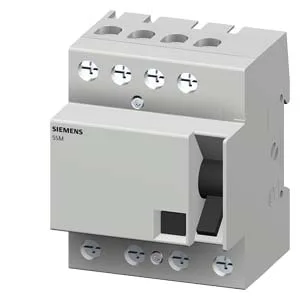
The short-time delay means it tolerates brief inrush or transient leakage without tripping — useful on circuits with connected electronics or motor drives that produce a short-duration ground-leakage pulse. Type B detection covers AC, pulsating DC, and smooth DC fault currents up to 1 kHz, so it is the right choice for variable-frequency drive outputs, UPS systems, and PV installations where pure AC-sensing RCCBs would be blind to DC fault components.
The 0.8 kA rated conditional short-circuit current per EN 60898 and IEC 61008-1 applies when the RCCB is backed by an upstream overcurrent device; that coordination figure is what you use for selectivity studies. The 4-pole design (3 phases + neutral) handles three-phase loads with a monitored neutral, typical for 400 V distribution in European-style panels. It can be installed in any position, which simplifies layout in crowded enclosures. The device is silicon-free, which matters for applications like automotive paint lines or semiconductor fabs where silicone outgassing can cause adhesion or contamination issues.
Snap-on DIN rail mounting (REG profile).