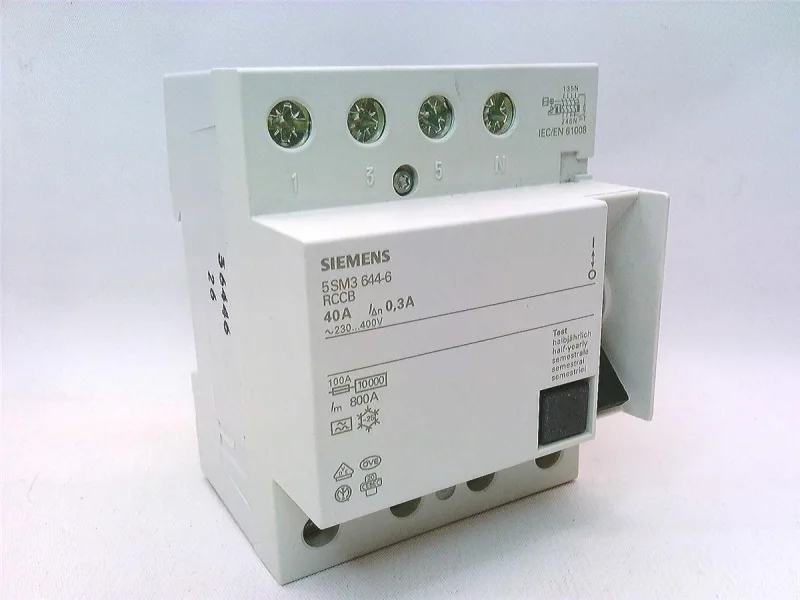
It's short-time delayed (selective S-type), so it coordinates with downstream RCCBs: the fault clears at the nearest device first, not nuisance-tripping the main.
40 A continuous at 40 °C ambient; at 50 °C it derates to 38.4 A, and at 70 °C to 32 A — so if the panel runs hot, the nominal load must stay under the derated curve. The 10 kA short-circuit current rating (SCCR) per IEC 61008-1 means it safely interrupts faults up to that level; the I²t let-through is 70,000 A²·s, which the upstream breaker must be coordinated to handle. Surge current resistance is 3 kA (8/20 µs waveform) — important for lines with lightning exposure or capacitor switching. The 300 mA residual trip is a standard for equipment protection (not personnel shock), typically used on branch circuits feeding fixed machinery or sub-distribution boards. Type B+ extends coverage to smooth DC fault currents up to the rated frequency — a requirement for modern power-electronics loads that generate DC leakage. Installation depth behind the panel is 70 mm.