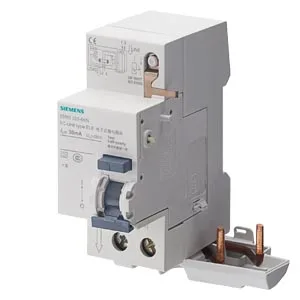
It's designed for instantaneous operation on 230/400 VAC, 50 Hz supply networks — standard European residential, commercial, and light industrial panels where the line frequency is fixed at 50 Hz. The 100 mA sensitivity makes this unit suitable for fire protection or general fault protection in circuits where a 30 mA device would cause nuisance tripping from normal leakage — think long cable runs, fixed equipment with some natural earth leakage, or sub-distribution boards. It's not a personal-protection device (that's the 30 mA class); 100 mA is about preventing cable overheating and arc faults.
Thermal derating — the real-world current rating
The 40 A nominal rating holds only at 40 °C ambient. Above that, the unit derates linearly: 37.2 A at 45 °C, 36 A at 50 °C, 34.8 A at 55 °C, 34 A at 60 °C, 33.2 A at 65 °C, and 32 A at 70 °C. If this RC unit lives in a crowded DIN-rail enclosure next to contactors or a transformer, expect the internal ambient to run 10–15 °C above the room temperature — size the upstream breaker accordingly, not off the 40 A nameplate.
What the AC-type residual current means for the signal
Type AC means this unit detects only sinusoidal AC residual currents — the classic sine-wave fault from a live-to-earth short on a linear load. It will not reliably detect pulsed DC, smooth DC, or high-frequency residuals from VFDs, LED drivers, or switched-mode supplies. If the downstream load includes any rectified or switched electronics, a Type A or Type B RC unit would be the correct choice; this Type AC is for purely resistive or inductive AC circuits without electronic front-ends.