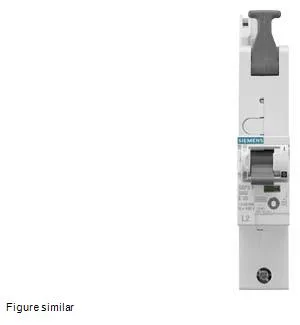
It breaks 25 kA per EN 60898 at 230/400 V AC, 50 Hz — that's the short-circuit capacity you need for a residential or light-commercial meter panel where fault levels are high but space is tight. The E curve means it holds longer on inrush than a B or C, so it pairs well with transformer-fed or motor-starting loads that draw a brief surge without nuisance tripping.
Mounts on a 40-mm busbar system per DIN 43870 Part 2 — that's the standard meter-panel rail in European residential and infrastructure builds. The 1.5 width units (about 27 mm on a DIN rail) leave room for adjacent breakers in a multi-pole assembly. Infeed at the box terminal, outgoing via spring-loaded terminals; wire range accepts 2.5 to 50 mm² solid or stranded, which covers everything from a 4 mm² lighting circuit up to a 35 mm² main feed.
Environmental and mechanical margins
Shock-rated 30 g for 11 ms, vibration 2 g per IEC 60068-2-6; that's enough for transport vibration and seismic zones without the contacts bouncing. Mechanical life 20,000 cycles typical — set-and-forget for a main breaker, but if you're switching it weekly as a disconnect, that's about 40 years of weekly operation.