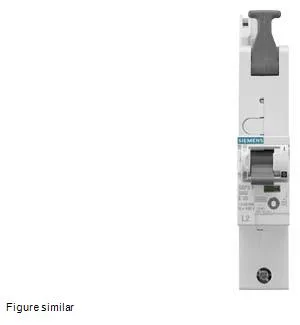
The Siemens SENTRON 5SP3750-2XX03 is a 1-pole main miniature circuit breaker (MCB) rated for 50 A with an E tripping characteristic and a 25 kA breaking capacity per EN 60898. It's designed as the main disconnect in residential and infrastructure meter panels, mounting on a 40-mm busbar system per DIN 43870 Part 2. The E-curve means it handles moderate inrush without nuisance trips — think motorized meters or capacitor banks — while still clearing faults fast. Conductor range covers 2.5 to 50 mm² solid or stranded, so it'll take the incoming service cable and the outgoing feeder without needing adapters.
Overvoltage category IV means it's rated for the utility-side surge environment at the service entrance, not just downstream distribution. The 6 kV surge voltage resistance backs that up. The E tripping curve is the key differentiator: it's a specialty curve between B and C for loads with a defined inrush characteristic — Siemens positions it for main breakers in meter panels where the connected load is known and the utility coordination demands a specific magnetic trip threshold. The 1.5 width units is narrower than a standard 2-module main switch, so it saves rail space in a crowded meter cabinet.
Mounting and deployment
This breaker is designed for busbar mounting on a 40-mm system per DIN 43870 Part 2 — the standard for European meter panels. The infeed is at the box terminal and the outgoing feeder uses a spring-loaded terminal, so it's a top-feed / bottom-out arrangement typical for main disconnects. The position of the supply cord is stipulated for installation in the lower section of the meter panel, meaning the line side comes from the meter or service cable below. The switch position indicator shows OFF = green, ON = red — a small thing, but it saves time during commissioning when you're tracing circuits in a dim meter room. Shock resistance is 30 g for 11 ms, vibration 2 g per IEC 60068-2-6 — it'll survive transport and a panel door slam, but it's not a mobile-equipment part.