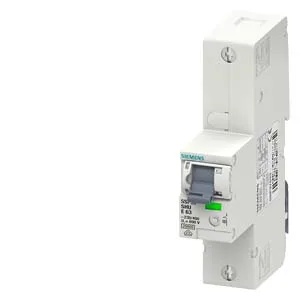
The E curve is a medium-delay characteristic — it sits between a standard B/C curve and a selective S curve — designed for main incoming feeders where you need a short time delay to ride through downstream inrush without nuisance tripping, but still fast enough to clear a hard fault. The 25 kA breaking capacity per EN 60898 means this breaker can safely interrupt a fault current up to 25 kA at the rated voltage, which covers most residential and light commercial service entrances in a 230/400 V network. The single-pole version (1P,) switches the line conductor only, intended for single-phase branch or as one pole of a multi-pole assembly on a busbar system. Terminal capacity accepts solid or stranded conductors from 2.5 mm² up to 50 mm² — that's a wide range, covering everything from a 2.5 mm² lighting circuit tail up to a 50 mm² main feeder. The box terminal design with infeed at the box terminal and outgoing via spring-loaded terminal makes it straightforward to land larger conductors without specialized lugs. Mounting is on a 40-mm busbar system per DIN 43870 Part 2, which is the standard meter-panel busbar pitch in European residential infrastructure. The breaker occupies 1.5 width units on the busbar.
Deployment context and environment
This breaker is built for residential buildings and infrastructure — think meter cabinets, distribution boards, and main load centers in apartment blocks or small commercial sites. Shock resistance is rated at 30 g, 11 ms duration, and vibration per IEC 60068-2-6 at 2 g, 5–150 Hz, so it holds up in transit and normal service vibration.