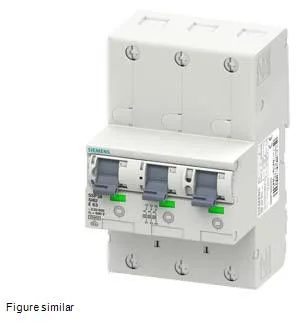
The E characteristic means it's built for a delayed trip — it handles short inrush currents better than a B or C curve, which is useful for transformer or capacitive loads where you don't want nuisance trips on startup.
Overvoltage category IV means it's rated for the main incoming supply — not just downstream sub-circuits — so it can be the first breaker after the utility meter. Temperature derating is published: 16 A at 30 °C, 15.2 A at 40 °C, 14.8 A at 45 °C, 14.4 A at 50 °C, 14 A at 55 °C. Wire range accepts 2.5 mm² minimum to 50 mm² maximum for both solid and stranded conductors — that's a wide range, letting you land anything from a small load circuit up to a main feeder. Saddle terminals and infeed at box terminal are standard, so wiring is straightforward with no special tools needed. IP40 with connected conductors — that's finger-safe for the front of the panel but not sealed against water ingress, so it belongs in an enclosure, not out in the weather. Depth is 76.3 mm, height 128 mm — standard MCB footprint, fits any DIN-rail enclosure with that clearance.
The integrated locking slide accepts a padlock, wire seal, or cable tie for lockout/tagout, which is a nice touch for maintenance isolation without adding an external lockout hasp. Supply cord position is any — top or bottom feed works, no orientation restrictions. Shock rated at 30 g for 11 ms, so it holds up in high-vibration environments like near large contactors or in mobile equipment.