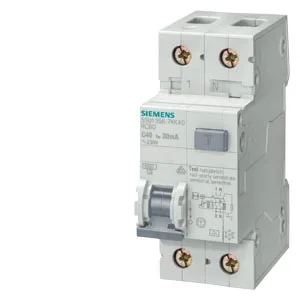
What it is and what it does
The Siemens SENTRON 5SU1656-1KK06 is a 2-pole (1P+N) RCBO — a combined residual-current circuit breaker with overcurrent protection, in a 36 mm wide (2 MW) housing. It's rated 6 A at 30 °C with a C-curve tripping characteristic, meaning it handles moderate inrush from motor or lighting loads without nuisance trips, while still clearing short circuits fast. The breaker carries a 6 kA breaking capacity per EN 60898 for domestic/commercial panels and a 25 kA rating per IEC 60947-2 for industrial distribution boards — a solid safety margin for most sub-distribution applications.
What the ratings mean for fit
The 6 A rating is at 30 °C ambient. This derates as temperature climbs — at 40 °C it's 5.7 A, at 50 °C it's 5.4 A, and at 70 °C it drops to 4.62 A. If this RCBO is going into a warm enclosure (say, next to a transformer or in a rooftop panel), use the derated figure, not the nameplate 6 A, to avoid nuisance tripping on continuous load. The C-curve (tripping characteristic class C) means magnetic trip occurs at 5–10 times rated current — 30–60 A for this 6 A unit. That's the standard choice for general-purpose distribution with motor or capacitive loads. The energy limitation class is 3, which keeps let-through energy low enough to protect downstream wiring and connected equipment. Breaking capacity is dual-rated: 6 kA per EN 60898 (the household standard) and 25 kA per IEC 60947-2 (the industrial standard). The 25 kA figure is what matters for industrial panels with high fault-current potential — it means this RCBO can safely interrupt a fault up to 25 kA without welding contacts or cascading failure upstream.
Where it goes in the panel
Mounts on standard DIN rail in any position — horizontal, vertical, flat — which is useful when the panel layout is tight. Installation depth is 70 mm, overall depth with terminals is 77 mm. The housing is IP20 rated only when the distribution board is installed and conductors are connected, so it's not for open-panel or washdown environments. It's halogen-free and silicon-free, which matters for installations where outgassing could corrode contacts or sensitive electronics — think data centers, medical equipment, or clean-room panels.
