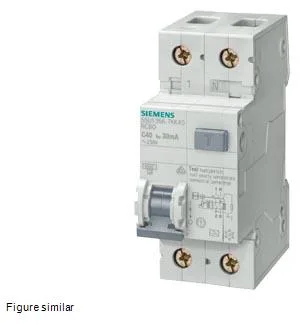
It's a Type A RCD with a 300 mA trip sensitivity, paired with a C-curve 16 A overcurrent characteristic and 6 kA breaking capacity.
Type A RCD means it detects pulsating DC fault currents — the kind you get from single-phase rectifiers, switched-mode power supplies, and variable-frequency drives. If your panel feeds electronics or motor drives downstream, a Type A is the minimum residual-current protection that won't nuisance-trip on smooth DC ripple. The 300 mA IΔn is a common specification for whole-circuit protection (not personnel shock protection, which typically uses 30 mA): it catches insulation faults and arcing without being so sensitive that cable capacitance trips it. The C-curve 16 A trips magnetically between 5× and 10× rated current (80–160 A), so it handles motor-starting inrush and transformer energization on loads up to roughly 3.5 kW single-phase.