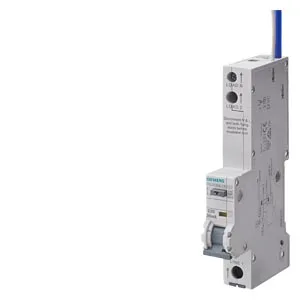
Rated 20 A at 30 °C on a 230/240 V AC supply, it occupies one modular width (18 mm) on a DIN rail. The 1P+N design switches the phase and switches the neutral solidly — no switched neutral contact to fail.
The 10 kA breaking capacity (both EN 60898 and IEC 60947-2) tells you this RCBO can safely interrupt a fault current up to 10,000 A at its rated voltage. That covers the prospective short-circuit current you'd typically find at the final distribution board in a residential or light commercial installation fed by a transformer of modest kVA. The B-curve characteristic means the magnetic trip activates at 3–5× In (60–100 A for this 20 A unit). That's fast enough to protect cable and equipment against short circuits, but it won't nuisance-trip on the inrush of a few fluorescent fittings or a small motor starting direct-on-line. If you're feeding a circuit with high inrush — say a bank of LED drivers or a small compressor — a C-curve sibling would be the better call. That covers most modern electronics — switched-mode power supplies, variable-speed drives, LED drivers — that can generate pulsating DC leakage. If your load includes three-phase rectifiers or frequency inverters that might produce pure DC fault current, you'd need Type B.
The 18 mm width (one modular unit) is the standard DIN-rail footprint for a 1P+N RCBO. Height is 125 mm, so it clears most 150 mm-tall consumer unit enclosures. IP20 protection applies when the distribution board is installed with conductors connected — that's the standard for inside an enclosure. Not rated for wet or dusty environments. The 4 kV surge voltage rating (impulse withstand) covers the transients you'd expect in a TN or TT system.