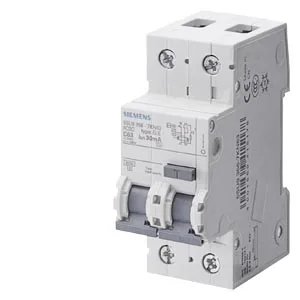
What it is and what it protects
The Siemens 5SU9353-7CN10 is a combined residual current device and miniature circuit breaker (RCBO) from the SENTRON family, integrating overcurrent and earth-leakage protection in a single 2-module-wide unit. It is a 1P+N design — one protected pole plus a switched neutral — rated 10 A with a C tripping characteristic and a 30 mA Type A residual-current trip. The C-curve (tripping between 5× and 10× In) suits moderate inrush loads like small motor starters, contactor coils, or lighting banks where a B-curve would nuisance-trip on startup. Type A residual-current detection catches both sinusoidal AC faults and pulsating DC fault currents — the standard requirement for single-phase electronics, variable-speed drives, and appliances with rectifier front ends. Breaking capacity is 4.5 kA per EN 60898, adequate for most domestic and light commercial sub-distribution boards where the prospective short-circuit current at the point of installation does not exceed that level. The 30 mA trip threshold provides supplementary protection against direct-contact shock in final circuits.
Panel fit and installation
This RCBO snaps onto standard 35 mm DIN rail (EN 60715) and occupies 2 modular width units (36 mm). Depth is 77 mm, installation depth 70 mm — confirm enclosure depth clearance, particularly in shallow consumer units or compact sub-distribution boards. Mounting position is unrestricted, and supply can enter from either top or bottom, which simplifies busbar routing. Rated insulation voltage (Ui) is 264 V AC, overvoltage category III, pollution degree 2 — standard for fixed-installation final circuits. IP20 rating applies only when installed in a distribution board with conductors connected; the device itself is not rated for exposed or wet locations.
Environmental and compliance
Rated for ambient temperatures from -40 °C to +75 °C, with maximum 95% humidity. Mechanical endurance is 10,000 switching cycles typical. Energy limitation class 3 means it limits let-through energy effectively under fault conditions, reducing stress on downstream wiring.
