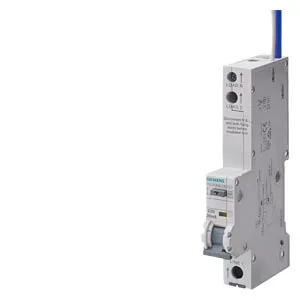
The Siemens 5SU9406-1KK06 is a 1P+N RCD-operated circuit breaker from the SENTRON 5SU9 series — essentially an RCBO that packs overcurrent and residual-current protection into a single 18 mm wide module. Because it's an instantaneous design (no intentional delay on the RCD side), it trips fast on earth faults — good for personnel protection in final circuits where you want the fault cleared before it escalates. The 1P+N configuration switches the live pole and monitors the neutral, so it fits single-phase sub-circuits in distribution boards.
Ratings and derating — what they mean on the panel
At 40 °C it's 5.64 A, at 45 °C it's 5.46 A, at 50 °C it's 5.22 A, and at 55 °C it drops to 4.86 A. If your panel runs warm — and most enclosed DIN-rail boards do — size the load against the derated figure, not the 30 °C headline. The operating ambient range is -25 to +45 °C, so above 45 °C you're outside the guaranteed spec window.