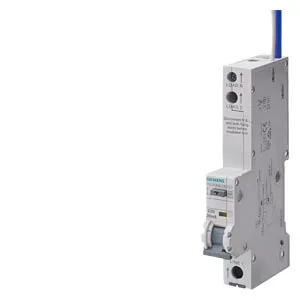
The Siemens 5SU9406-1KK20 is a 1P+N RCD-operated circuit breaker (RCBO) from the SENTRON 5SU9 series, combining overcurrent protection and residual current detection in a single 18 mm wide module. It carries a 20 A rated current at 30 °C with a Type C tripping characteristic, meaning it handles inrush currents from motor or lighting loads without nuisance tripping. The breaking capacity is 6 kA per both EN 60898 and IEC 60947-2, so it safely interrupts fault currents up to that level in a 230/400 V AC installation. The RCBO detects AC fault currents only (Type AC RCD), and the instantaneous design means no intentional time delay on the residual current element — it trips as soon as the leakage exceeds the threshold. The 1P+N configuration switches the live pole and monitors the neutral, but only the live pole is protected against overcurrent.
At 18 mm wide (1 width unit), this RCBO snaps onto a standard DIN rail and accepts conductors from 0.75 mm² up to 35 mm² solid or stranded. The installation depth is 70 mm, with an overall depth of 77 mm — check your enclosure depth if you are retrofitting into a shallow panel.
At 40 °C it derates to 18.8 A, at 45 °C to 18.2 A, at 50 °C to 17.4 A, and at 55 °C to 16.2 A. Maximum power loss is 0.75 W, so heat buildup from a single unit is negligible, but in a dense row of RCBOs the cumulative dissipation can raise cabinet temperature — factor the derating curve into your thermal budget.