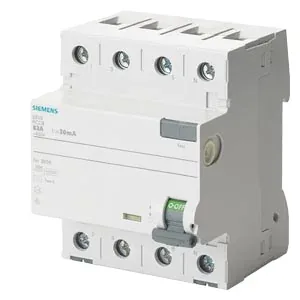
RCCB for 400 V AC distribution — 40 A, 30 mA, Type A, short-time delayed
The Siemens SENTRON 5SV3344-6LB01 is a 4-pole residual current operated circuit breaker (RCCB) rated for 40 A at 400 V AC, 50/60 Hz. It trips on a 30 mA residual current and carries a 10 kA short-circuit current rating (SCCR) per IEC 61008-1. This is a short-time delayed (selective) RCCB — the switching function is intentionally delayed to coordinate with downstream devices. That means it will ride through short-duration earth faults (up to its surge current resistance of 3 kA, per) without tripping, letting the downstream MCB or RCBO clear the fault first. Use it at the incoming supply or as a main switch in a sub-distribution board where selectivity is required. Depth is 70 mm, which matches standard 60 mm grid spacing enclosures — no panel depth surprises.
Fault energy handling and coordination
The 5SV3344-6LB01 is rated for a maximum let-through current of 5 200 A and a permissible I²t value of 58 000 A²·s. These numbers define the energy the device can pass during a fault before clearing — critical for verifying that downstream cables and terminals are thermally protected. It also carries a rated impulse withstand voltage of 0.8 kA per IEC 61008-1 and a surge current resistance of 3 kA (8/20 µs waveform). That surge rating is what keeps it from nuisance-tripping when a nearby lightning strike or capacitor bank switching injects a transient into the earth path. The maximum permissible series fuse is 100 A, which limits the fault current the RCCB sees if installed behind a larger upstream breaker.
Silicon-free construction — relevant for automotive or paint-shop environments where silicone outgassing can cause adhesion failures. Power dissipation is 1.8 W per pole at rated current in hot operating state — 7.2 W total for the 4-pole unit. That is modest for a 40 A device, but worth summing in a densely packed enclosure to stay below the cabinet's thermal limit.