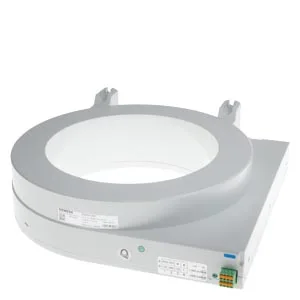
It is designed for AC and DC systems, making it suitable for mixed-frequency fault detection including smooth DC and high-frequency components. The 210 mm opening passes large cable bundles or busbars without splitting, and the 630 A rating positions it for main feeder or large subdistribution monitoring in commercial or industrial panels.
The 630 A rated operational current is the continuous thermal current the transformer can carry through its primary window — sized for a 630 A busbar or cable assembly, not for a single small conductor. The 300 mA minimum residual current is the lowest earth-leakage signal the core can detect; Type B design means it responds to AC sinusoidal, pulsating DC, smooth DC, and mixed-frequency residual currents up to 1 kHz or more, covering VFD-fed motor circuits and UPS-fed loads that standard Type A transformers miss. The 210 mm internal diameter accepts conductors up to roughly 200 mm bundle diameter — think multiple 300 MCM cables or a 5×50 mm busbar. The 690 V rated voltage at 50/60 Hz and 8 kV surge withstand confirm it fits 400/480 V systems with margin.
Deployment context
The transformer mounts via its own bracket or DIN-rail adapter (not a snap-on DIN footprint — check the mounting kit). At 304.5 mm deep, 323 mm wide, and 80 mm high, it needs a panel depth of at least 320 mm to clear the rear terminals. The plug-in terminal connections accept up to 6 conductors of 0.75 mm² each — fine for the secondary wiring to the RCD or relay, but the primary busbar is what passes through the 210 mm window. IP20 at the terminals means it is for enclosed panel use only, not washdown. The 2.5 VA maximum apparent power consumption tells you the burden the secondary imposes on the monitoring relay — stay under that limit when selecting the connected RCD or relay module.
The 5SV8704-2KK carries an Active lifecycle status. It is a current-production Siemens SENTRON catalog item. No official successor is listed — this is the current Type B summation transformer in the 210 mm / 630 A class.