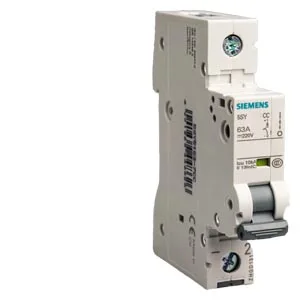
It protects branch circuits against overcurrent and short-circuit faults in industrial control panels, mechanical engineering installations, and distribution boards. Breaking capacity is 10 kA per IEC 60898 at 400 V AC, with a 5 kA rating per UL 1077 and CSA C22.2 No. 235 for North American acceptance.
Rated 400 V AC, single-pole, with a maximum DC voltage of 72 V — so it handles single-phase AC circuits at standard line voltages and low-voltage DC control loops, but not a 125 V DC battery bank. Energy limiting class 3 means it restricts let-through energy well — useful for protecting downstream equipment during a fault. Terminals accept 0.75 to 35 mm² solid or stranded copper, with a screw torque range of 2.5 to 3.5 N·m. That covers everything from small control wiring up to substantial feeder conductors. The combined terminal design (top and bottom) accepts both busbar forks and cable lugs without modification. Touch protection is built in — no separate finger-safe shrouds needed for the line side. The derating curve is specified: max 95% RH at 55 °C, dropping to 55% at 70 °C and 35% at 75 °C — relevant if the breaker lives near a heat source or in a sealed enclosure.
Construction and compliance
Halogen-free and silicon-free construction — important for environments where outgassing could contaminate optics, contacts, or clean-room processes. The product designation per DIN EN 61346-2 and DIN EN 81346-2 is F (protective device). Sealable terminals allow the installer to lock the cover screws against tamper after commissioning.