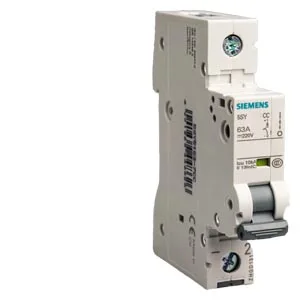
What it is and what it does
The Siemens 5SY4110-7CC11 is a 1-pole miniature circuit breaker from the SENTRON series, designed for railway applications. It carries a C-curve tripping characteristic, meaning it handles moderate inrush currents typical of motor and transformer loads before tripping on sustained overload. The interrupting capacity is rated at 10 kA according to EN 60898, so it safely clears a fault up to that level on a 400 V AC single-phase or multi-phase circuit. The 18 mm width (1 modular unit) fits standard DIN-rail enclosures, and the breaker accepts supply from either end.
Key ratings and what they mean for fit
The C-curve trips between 5 and 10 times rated current on short-circuit — a standard choice for general-purpose industrial loads where you need to avoid nuisance trips from motor start-up. The 10 kA breaking capacity per EN 60898 is the maximum fault current the breaker can interrupt at its rated voltage; for a 400 V AC panel fed from a transformer of modest size, that covers most secondary-side faults. The breaker is rated for pollution degree 3 and overvoltage category III, which matches typical industrial control panels where conductive pollution and transient overvoltages are expected. The operating temperature range spans -40 °C to 75 °C, so it can sit in an unheated enclosure or near a hot machine.