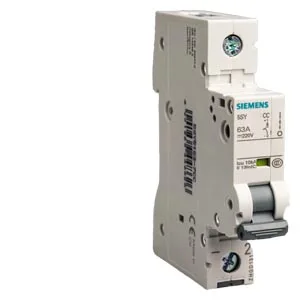
What it is and what it protects
The Siemens 5SY4114-7CC is a 1-pole SENTRON miniature circuit breaker with a C-curve trip characteristic, rated 0.3 A at 230/400 V AC, 50/60 Hz. It breaks fault currents up to 10 kA per EN 60898, which covers the typical prospective short-circuit current on most distribution boards and sub-panels in industrial and commercial installations. The C-curve means it trips between 5 and 10 times rated current — standard for protecting inductive loads like contactor coils, small transformers, and control-circuit solenoids where a brief inrush won't nuisance-trip a B-curve device. This is a single-module (18 mm wide) breaker that snaps onto a DIN rail. It is rated for pollution degree 3 and overvoltage category III, so it's suited for fixed-installation panels in factory environments — not just clean control cabinets. The IP20 rating (with connected conductors) means it's protected against finger contact but not against moisture; keep it inside an enclosure rated for the ambient conditions.
Thermal derating — the real-world current rating
The 0.3 A rating holds at 35 °C ambient. At 40 °C it derates to 0.28 A, at 45 °C to 0.26 A, at 50 °C to 0.25 A, and at 55 °C to 0.23 A. If your panel runs hot — say 50 °C inside a sealed enclosure — the breaker can only carry 0.25 A continuously without nuisance tripping. That matters when you're protecting a 24 VDC control transformer or a PLC power supply that draws close to the und derated value; you need to account for the actual ambient temperature inside the panel, not the room temperature.
Mounting and wiring
The breaker mounts in any position on a DIN rail via the quick-assembly system — no tools needed to clip it on or off. Installation depth is 70 mm; overall depth including the front toggle is 76 mm. It occupies one modular width (18 mm), so it fits standard distribution boards and sub-panels. The combined terminals at top and bottom accept both busbar and cable connections, and the terminals are sealable for applications that require tamper-proofing after commissioning. The supply can be fed from either end — top or bottom — without affecting the trip performance. Neutral conductor switching is not provided (single-pole only), so the neutral must be connected through a separate terminal block or a 2-pole breaker if isolation on both poles is required.