If your line has motor inrush or high inductive loads, a C-curve sibling would be the better fit, but for most panel auxiliaries this B-curve holds fine. The 10 kA breaking capacity at 400 V AC (per EN 60898) means it can safely interrupt a fault current up to 10,000 amps without welding contacts or cascading failure upstream. That's adequate for most secondary distribution panels fed by a transformer of 630 kVA or less. For single-phase operation it's rated at 230 V and 440 V AC, and DC operation up to 72 V. Temperature derating matters in a sealed cabinet: the breaker is rated for ambient up to 75 °C, but humidity must be kept under 35% above 70 °C. In a hot, damp railcar junction box, that derating curve is what keeps the trip threshold predictable. Vibration resistance is specified per IEC 60068-2-6 at ±1 mm from 5 to 25 Hz and 50 m/s² from 25 to 150 Hz — that covers the rail vehicle body and bogie-mounted equipment spectrum. If your application sees higher shock or sustained vibration (e.g., off-road vehicles), this breaker is still a candidate but verify against your specific vibration profile.
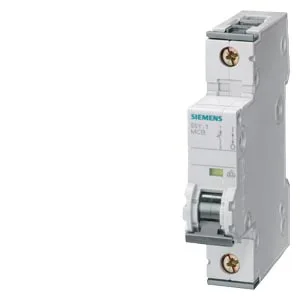
Siemens 5SY4120-6CC11 SENTRON MCB, 1P B-curve 10kA
Siemens SENTRON 5SY4120-6CC11, 1-pole miniature circuit breaker, B-curve, 10 kA per EN 60898, designed for railway applications, 18 mm width.
Specifications
| Parameter | Value |
|---|---|
| Product designation | Miniature circuit breaker |
| Brand name | SENTRON |
| Number of poles | 1 |
| Pole design | 1P |
| Application suitability | Mechanical engineering / industry |
| Parameter | Value |
|---|---|
| Tripping characteristic class | B |
| Energy limitation class | 3 |
| Overvoltage category | III |
| Parameter | Value |
|---|---|
| Mounting position | any |
| Fastening method | Quick assembly system |
| Combined terminal, top | Yes |
| Combined terminal, bottom | Yes |
| Width | 18 mm |
| Height | 90 mm |
| Depth | 76 mm |
| Installation depth | 70 mm |
| Modular width units | 1 |
| Torque, min. | -40 °C |
| Torque, max. | 75 °C |
| Sealable | Yes |
| Parameter | Value |
|---|---|
| IP protection class | IP20, with connected conductors |
| Pollution degree | 3 |
| Halogen-free | Yes |
| Silicone-free | Yes |
Product details
Frequently asked questions
How do I get current pricing and availability for 5SY4120-6CC11?
Submit an RFQ through this listing. Pricing and stock are confirmed at quote time through our independent distribution network — no automated price or lead time is published here.
Will 5SY4120-6CC11 drop into a panel specified around 5SY4116-6CC without rewiring?
Yes, the 5SY4120-6CC11 shares the same 18 mm width, 1-pole footprint, and DIN-rail mounting as the 5SY4116-6CC. It's a direct mechanical swap — same terminal layout, same busbar compatibility. The difference is the rated current (20 A vs 16 A) and the breaking capacity rating, so verify the upstream protection coordination if you're uprating.
What compliance documentation does this brand provide for 5SY4120-6CC11?
The SENTRON 5SY series carries CE marking per the Low Voltage Directive and is designed to EN 60898. The breaker is halogen-free and silicon-free, and rated for pollution degree 3 and overvoltage category III. For specific RoHS/REACH declarations, refer to the manufacturer's declaration of conformity available from Siemens.