What it is and what it does
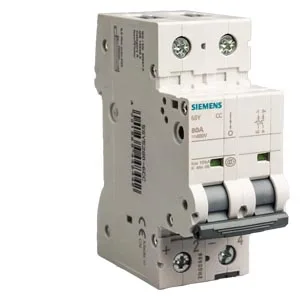
The Siemens 5SY4250-6KK11 is a 2-pole miniature circuit breaker from the SENTRON series, rated 50 A at AC with a B tripping characteristic. It protects branch circuits against overload and short-circuit, with a breaking capacity of 10 kA per EN 60898 and 15 kA per IEC 60947-2. The B curve means it trips at 3–5 times rated current, making it suitable for resistive and general-purpose loads where inrush is moderate — think lighting, heating, or control transformers, not motor starting. The 36 mm width (2 modular units) snaps onto a DIN rail via the quick assembly system, and it can be mounted in any position. The IP20 rating with connected conductors means it's protected against finger contact but not water ingress — standard for inside a panel. Combined terminals at top and bottom simplify daisy-chaining or busbar feed.
Ratings and what they mean for fit
The 50 A rating is at 35 °C ambient. At 40 °C it derates to 47.6 A, at 50 °C to 45.1 A, and at 60 °C to 42.4 A. If your panel runs hot — common in sealed enclosures or near heat sources — you need to account for the derating curve rather than relying on the nominal 50 A. The breaking capacity tells you the maximum fault current the breaker can safely interrupt. At 10 kA per EN 60898 it covers most residential and light commercial panels. The 15 kA per IEC 60947-2 gives headroom for industrial distribution where fault levels are higher — for example, near a large transformer or in a plant with high short-circuit capacity. Overvoltage category III means it's rated for fixed installation downstream of the main distribution board. Pollution degree 3 means the breaker is designed for conductive pollution or dry non-conductive pollution that becomes conductive due to condensation — typical in industrial environments. The energy limitation class 3 indicates it limits let-through energy effectively, reducing stress on downstream equipment during a fault.