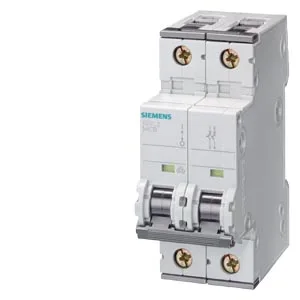
The Siemens SENTRON 5SY4525-6 is a 2-pole miniature circuit breaker wired as 1P+N — it switches the live conductor and breaks the neutral, but the neutral pole isn't overload-protected. Rated 25 A at 230 V AC with a B tripping characteristic, meaning the magnetic trip fires at 3–5× rated current — fast enough for general-purpose resistive and light inductive loads, but not so fast it nuisance-trips on motor inrush. The 10 kA breaking capacity per EN 60898 covers the vast majority of domestic and light commercial panel fault levels; the 20 kA per IEC 60947-2 gives you the headroom if you're specifying to the industrial standard and need selectivity with an upstream device. At 36 mm wide (2 width units on a DIN rail), it fits a standard 18 mm-per-pole grid. The 76 mm depth and 70 mm installation depth mean it clears most shallow enclosures, and the 90 mm height sits flush with adjacent SENTRON devices. Mounting position is any, so you can lay it sideways in a tight gland plate area without derating.
Terminal capacity and installation feel
Accepts solid or stranded copper from 0.75 mm² up to 35 mm². Combined terminal top and bottom allows looping through the breaker. Sealable, halogen-free, silicon-free — so it's safe for clean rooms, food processing areas, and any environment where outgassing from a fault could contaminate product or sensitive electronics. IP20 with conductors connected is standard for enclosed panel mount; no extra finger-duct cover needed inside the cabinet. The humidity derating curve (max 95% RH at 55 °C, dropping to 35% at 75 °C) is the limiting factor in tropical or washdown zones — if your panel sees sustained high humidity and high temp, check the enclosure climate.
DC ratings for mixed-voltage panels
Rated for DC circuits up to 72 V with a 15 kA breaking capacity per IEC 60947-2. That covers 48 V control power and 60 V instrumentation supplies common in industrial panels. The 15 kA DC rating is lower than the AC figure, so if you're using it on a large battery bank or a DC bus, verify the prospective fault current is under that threshold.